How Does a Period Underwear Manufacturer Choose Breathable Materials?
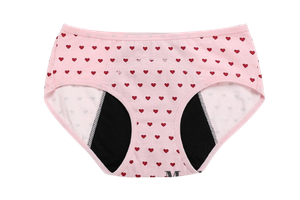
A period underwear manufacturer chooses breathable materials by testing the whole gusset, not by judging one fabric. A practical program checks air permeability under ASTM D737, liquid moisture transport with AATCC TM195, drying behavior, water-vapor resistance, rewet, thickness, stretch, and wash durability. ASTM D737-18(2023) covers knitted, woven, nonwoven, coated, and layered fabrics, while ISO 11092:2026 measures thermal and water-vapor resistance in multilayer textile assemblies. A manufacturer should compare several constructions under identical conditions because adding an absorbent layer, adhesive, or waterproof film can change moisture movement even when the face fabric remains unchanged.
Period underwear is harder to ventilate than ordinary briefs because the gusset may contain four or five functional materials within a small area. A typical build includes a skin-contact layer, transfer layer, absorbent textile, leak-resistant membrane, and outer fabric. Each layer adds thickness and resistance to air or vapor movement, so adding 20% more absorbent textile does not automatically produce a better garment if drying time and surface wetness also rise.
Fiber chemistry is only the starting point. Cotton absorbs moisture readily but can retain water inside the fiber, while polyester takes up much less moisture internally and can move liquid through capillary channels created by yarn and knit construction. Nylon is often used where a thin, smooth, stretchable fabric is needed, while modal and lyocell provide soft hand feel and strong interaction with moisture.
Those differences explain why fiber percentage alone gives limited information. Two fabrics listed as 90% polyester and 10% elastane can perform very differently when yarn diameter, loop density, fabric weight, finishing, and thickness change. ASTM D737 notes that textile construction and finishing can materially alter air permeability, including changes caused by yarn structure and surface treatment.
A manufacturer therefore compares finished fabric specifications rather than buying by composition name. In early sampling, testing 3 to 5 candidate fabrics under the same conditioning and test method gives more useful information than comparing supplier brochures produced under different laboratory conditions.
A soft 120 gsm knit can feel cooler in the hand than a 150 gsm knit, yet the lighter fabric may still move less air if its loops are tighter or its finish closes more surface area.
The skin-contact layer needs special attention because it controls the first few seconds after fluid reaches the garment. High total absorption is not the main job at this position. The material should receive liquid quickly, move it downward, and leave limited moisture available to return to the skin when pressure is applied.
AATCC TM195 was developed to measure and classify liquid moisture management in knitted, woven, and nonwoven fabrics. It considers how fabric structure, fibers, yarns, water resistance, absorption, and wicking affect liquid movement. For development work, comparing at least 5 specimens per candidate helps expose inconsistent finishing or knitting that a single specimen can miss.
Surface rewet should be checked beside liquid transfer. A top fabric may absorb fast during the first 30 seconds but still feel wet if pressure pushes stored liquid back toward the surface. Period underwear is compressed while sitting, walking, cycling, or sleeping, so a supplier claim such as “fast wicking” should be supported by acquisition and rewet measurements on the finished multilayer sample.
Once fluid leaves the surface, the absorbent layer has to spread and retain it without becoming unnecessarily thick. Adding a second absorbent fabric can raise storage capacity, but it also increases textile mass, drying time, seam bulk, and resistance to vapor movement. A development team should therefore compare capacity per millimeter of thickness rather than judging capacity alone.
| Property checked | What the manufacturer learns | Practical comparison |
|---|---|---|
| Air permeability | How easily air passes through the textile | Test face fabric and full gusset |
| Liquid transfer | How quickly fluid leaves the skin side | Compare 3–5 constructions |
| Rewet | How much moisture returns under pressure | Test after controlled fluid loading |
| Thickness | How bulky the gusset becomes | Measure before and after washing |
| Drying | How long retained moisture remains | Use identical temperature and airflow |
| Vapor resistance | How easily moisture vapor moves | Test the multilayer assembly |
The waterproof layer creates another trade-off. A leak barrier must resist liquid penetration, but a solid film can reduce airflow sharply. Many reusable underwear constructions therefore use thin polyurethane-based membranes or laminated textiles designed to resist liquid while still allowing some water vapor to move through the material.
Water-vapor movement should not be confused with air permeability. A structure can have low airflow and still allow vapor transfer. ISO 11092:2026 measures thermal and water-vapor resistance under steady-state conditions for fabrics, films, coatings, foams, leather, and multilayer assemblies, which makes the method relevant when comparing a laminated gusset rather than a single knit.
Breathability should be measured after lamination, because the membrane is not the only layer controlling vapor movement.
Adhesive coverage can change the result again. A membrane may perform well in its original roll form, but a heavy continuous adhesive layer can block part of the surface available for vapor transfer. Manufacturers usually need trial laminations with controlled adhesive weight, temperature, pressure, and bonding speed before comparing finished structures.
For the same reason, an incoming membrane report should not replace testing of the completed gusset. A useful pilot run may compare 3 adhesive settings and 3 laminate constructions, producing 9 combinations before sewing full garments. The goal is not a universal number; it is finding which assembly maintains leak resistance without creating unnecessary stiffness, thickness, or slow drying.
Body fabric also matters because the gusset covers only part of the underwear. A nylon-elastane or polyester-elastane body can dry faster than a heavier cotton construction, while cotton or cellulosic blends may provide the hand feel preferred for everyday products. The useful choice depends on climate, garment cut, activity, and intended wear time.
Stretch changes fabric geometry as well. A knit measured while relaxed is not identical to the same textile stretched 10% or 20% across the body. Loop openings, thickness, contact area, and surface pressure can change during wear, so fit samples should be tested on bodies or forms rather than assessed only as flat fabric swatches.
Wash testing comes next because period underwear is a reusable product. Laundering can change shrinkage, surface texture, absorbency, membrane bonding, elasticity, and drying time. A material package that passes initial testing but delaminates or loses moisture-management performance after repeated washing is not suitable for a product expected to be reused for many cycles.
AATCC's 2026 proficiency program lists separate methods for moisture management, vertical wicking, horizontal wicking, drying time, drying rate, and water-vapor transmission, showing that textile moisture performance cannot be represented by one measurement. A manufacturer can build a wash protocol around 5, 10, 25, and 50 cycles to see when meaningful changes begin, while keeping detergent dose, water temperature, and drying method consistent.
Changes should be recorded as percentages rather than comments such as “slightly worse.” If a sample measures 2.4 mm before laundering and 2.7 mm afterward, thickness has increased about 12.5%. If drying time rises from 180 minutes to 225 minutes, the increase is 25%. Those figures make supplier and construction comparisons easier.
Production consistency then becomes part of material selection. ASTM D737 describes air-permeability testing as suitable for acceptance testing of commercial shipments and notes that laboratory differences should be investigated when results are materially different. A factory can use the same principle for incoming rolls, laminate lots, and finished gussets.
A practical approval plan may sample 5 pieces from different positions of a roll rather than cutting every specimen from one area. For a larger lot, specimens can also be drawn from the beginning, middle, and end of production. If one region differs by 15% or more from the established internal range, the manufacturer has a reason to check knitting, finishing, coating, or lamination conditions before bulk sewing continues.
Material specifications should therefore include more than fiber content and gsm. Thickness tolerance, stretch and recovery, air permeability, liquid transfer, rewet, drying behavior, waterproof performance, dimensional change, and laminate appearance can all be recorded with the test method used. Supplier data and factory data need the same test conditions before the numbers can be compared fairly.
Product type changes the acceptable balance. Light-flow underwear can use a thinner absorbent package and place more emphasis on low bulk and quick drying. Overnight underwear may need longer leak-resistant coverage and greater retention. Sports styles deal with menstrual fluid plus perspiration, so body fabric drying and vapor movement receive more attention.
A period underwear manufacturer should therefore avoid using one material stack for every style simply because it is easier to purchase. If a light-flow product contains 30% more absorbent textile than its actual use case requires, the added material can increase drying time and thickness without providing a noticeable benefit during ordinary wear.
Cost should be compared against measured performance rather than fabric descriptions. A more expensive wicking knit is useful when repeated testing shows lower rewet or faster transfer. A higher-priced membrane is harder to justify when a lower-cost option produces comparable vapor resistance, leak resistance, wash stability, and flexibility across 5 or more production samples.
The final material approval should use the complete sewn garment. Seams can compress absorbent textiles, edge stitching can alter fluid spread, elastics can change local pressure, and overlapping layers can dry more slowly than flat laboratory pieces. Full garments also reveal whether the gusset becomes stiff, noisy, warm, or visibly bulky during movement.
Wear trials add information that laboratory instruments cannot provide. A small development round of 10 to 20 wearers can compare perceived wetness, heat, fit, drying sensation, and bulk across matched prototypes. The sample is too small for broad population claims, but it is useful for finding construction differences before larger validation work.
When laboratory data, wash results, and wear feedback point in the same direction, material selection becomes easier to defend. A breathable period underwear structure is therefore chosen from measured interaction among fiber, knit, absorbent mass, membrane, adhesive, stretch, washing, and garment construction rather than from a single supplier statement such as “breathable fabric.”