What a Complete 10 Barrel System Includes
A complete 10 BBL brewery is a package of thirteen published items, not a kettle and a hopeful shopping list. HGMC publishes the whole brewery system for this size item by item: a 10 BBL mash/lauter tun, a 10 BBL steam-heated kettle and whirlpool, a 20 BBL hot water tank, two pumps, wort pipes, a plate heat exchanger, a platform, four 10 BBL fermentation tanks, glycol and cooling equipment, a CIP unit and a semi-automatic control cabinet.
The published cost example for that package sits between about US$75,000 and US$200,000, with the note that valves, pipes, a steam boiler and other site requirements move the figure.
Key takeaways
- The published bill of materials for a 10 BBL plant has thirteen lines, from the mash tun through to the control cabinet, and the four fermentation tanks are the largest single capacity item.
- The 20 BBL hot water tank is twice the brew length, which is what lets you clean and brew on the same day without waiting for water.
- The published example cost of about US$75,000 to US$200,000 does not include a steam boiler, and the note attached to it says valves, pipes and site requirements move it.
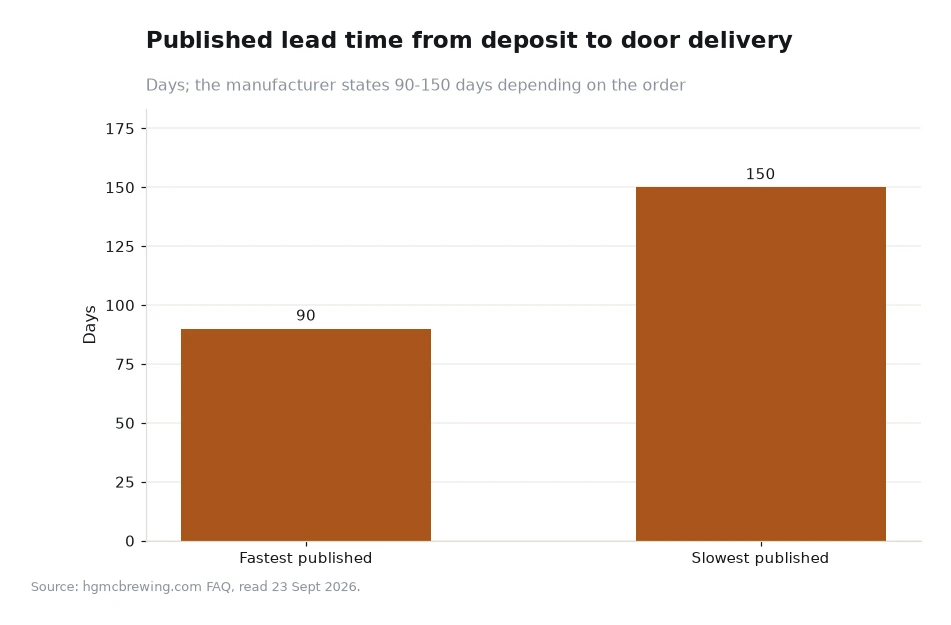
- Delivery runs from deposit to door delivery in 90 to 150 days depending on the order, so the build programme has to fit inside that window.
The published bill of materials, item by item
The brewhouse starts with a 10 BBL mash/lauter tun and a 10 BBL kettle and whirlpool tun, and the kettle is published as steam heated. Behind them sits a 20 BBL hot water tank, twice the brew length, which serves as both strike water and cleaning water; a 3 cubic metre per hour wort pump and a hot water pump move the liquid; stainless steel 304 wort pipes connect the vessels; and a 10 square metre plate heat exchanger takes the wort down to pitching temperature.
An operation platform gives the brewer access to the vessel manways and valves. For fermentation the package includes four 10 BBL fermentation tanks, supported by a glycol water tank, a chiller and cooling pipes and valves. Cleaning and control close the list: a CIP unit, and a control cabinet with a semi-automatic control system, which is the middle of the three published control levels.
Reading the list in that order is instructive. The brewhouse is two vessels and a hot water tank; the tank farm is four fermentation vessels and a glycol loop; and the rest is the equipment that connects them and keeps them clean. Nothing in the list is optional if you intend to brew and package continuously, and nothing in it is a spare.
| Group | Published items | Specification | What it does |
|---|---|---|---|
| Brewhouse | Mash/lauter tun and kettle/whirlpool tun | 10 BBL each, kettle steam heated | Mash conversion, boil and whirlpool in one sequence |
| Hot liquor and transfer | Hot water tank, wort pump, hot water pump | 20 BBL tank, 3 cubic metre pumps | Supplies strike and cleaning water and moves wort |
| Heat exchange and piping | Plate heat exchanger, wort pipes | 10 square metres, stainless steel 304 | Cools wort to pitching temperature between vessels |
| Fermentation | Four fermentation tanks | 10 BBL each | Carries the batch through fermentation and conditioning |
| Cooling loop | Glycol water tank, chiller, cooling pipes and valves | Sized to the tank volume | Holds fermentation temperature and crashes the batch |
| Cleaning and control | CIP unit and control cabinet | Semi-automatic control system | Cleans the loop and runs the brewhouse sequence |
Why the four tanks define the rhythm
The tank count is what turns a brewing day into a production plan. A 10 BBL batch is about 1,174 litres, so four 10 BBL fermentation vessels give roughly 40 BBL of tank volume behind a 10 BBL brewhouse, which is enough to keep brewing weekly once the rotation is running and enough slack to hold a batch back for an extra few days when it needs it.
The hot water tank is the other ratio worth noticing. At 20 BBL against a 10 BBL brew length, the published package assumes that cleaning and brewing happen on the same day, which is the normal pattern in a small plant, and that nobody wants to wait for the hot liquor tank to refill before starting the CIP cycle. Buying a smaller hot water tank saves little and costs time every single brew day.
What the published range covers, and what moves it
The published example is clear about its own limits: a complete 10 BBL package comes in around US$75,000 to US$200,000, and valves, pipes, a steam boiler and other requirements change the figure. Read that as three separate budgets. The first is the equipment in the list above. The second is the site work and the utilities, including the boiler that steam heating implies. The third is freight, unloading and the commissioning visit, which depends entirely on where your building is.
The semi-automatic control cabinet belongs to the middle control level, so the package as published is already beyond a plain set of temperature controllers but short of the fully automatic panel with curve indication and printed production records. That is a decision worth making deliberately rather than by default, because the panel is easier to specify at the order stage than to retrofit after the plant is running.
Worked example: what a 10 BBL brewhouse can produce
My assumptions, stated so you can replace them: a 10 BBL brew length taken as about 1,174 litres, four fermentation tanks on a 21-day cycle of 14 days fermentation and 7 days conditioning, brewing once a week for 50 weeks, and 6 per cent loss across transfer and packaging.
Step one, annual brews: 50 weeks multiplied by one brew a week is 50 brews. Step two, gross volume: 50 multiplied by 1,174 litres is 58,700 litres a year, which is about 587 hectolitres using 100 litres to the hectolitre. Step three, saleable volume: 58,700 multiplied by 0.94 is 55,178 litres, about 552 hectolitres, or roughly 472 BBL at 117 litres to the barrel.
Step four, the tank check: one tank turns 365 divided by 21, about 17.4 times a year, so 50 brews need 50 divided by 17.4, which is 2.9 tanks. Four tanks therefore cover a weekly brew with about a third of the farm free for a slower beer or a batch that needs longer conditioning. Step five, the hot water check: 20 BBL is 2,348 litres, so the published tank holds two brews of strike water or one brew plus a full cleaning cycle, which is the point of sizing it at twice the brew length.
Frequently asked questions
What is included in a complete 10 BBL brewery equipment system?
The published list has thirteen items: a 10 BBL mash/lauter tun, a 10 BBL steam-heated kettle and whirlpool, a 20 BBL hot water tank, a wort pump and a hot water pump, stainless steel 304 wort pipes, a 10 square metre plate heat exchanger, an operation platform, four 10 BBL fermentation tanks, a glycol water tank, a chiller, cooling pipes and valves, a CIP unit and a semi-automatic control cabinet.
How much does a complete 10 BBL system cost, and how long is delivery?
The published example is around US$75,000 to US$200,000 for a complete 10 BBL package, with valves, pipes, a steam boiler and other requirements moving the figure. Delivery runs from deposit to door delivery in 90 to 150 days depending on the order.
Use the list as your enquiry
Send the published bill of materials back to the supplier with your site conditions attached: whether you can install a steam boiler, how much power the panel can draw, where the chiller will stand and how the crates will be unloaded. A list that travels with those answers turns into a scope with no gaps in it, which is the only kind of scope you can compare between suppliers.
Two pages are worth reading first. The large commercial plants material shows how the same components are specified at bigger sizes, which is useful if you expect to grow, and the beer brewing equipment pages cover the process equipment around the package. Published after-sales support includes installation, commissioning, operator training, maintenance and spare parts, so ask which of those are inside the price you are quoted.
The bill of materials, cost range, warranty and delivery window come from the manufacturer's own website, read 23 Sept 2026; the annual volumes and tank counts above are my own arithmetic from the stated assumptions.[1] Warranty cover runs 6 years on tank accessories and electronic components against manufacturing defects from the factory, used within scope.