OEM or ODM for a Home Fragrance Line: What to Verify First
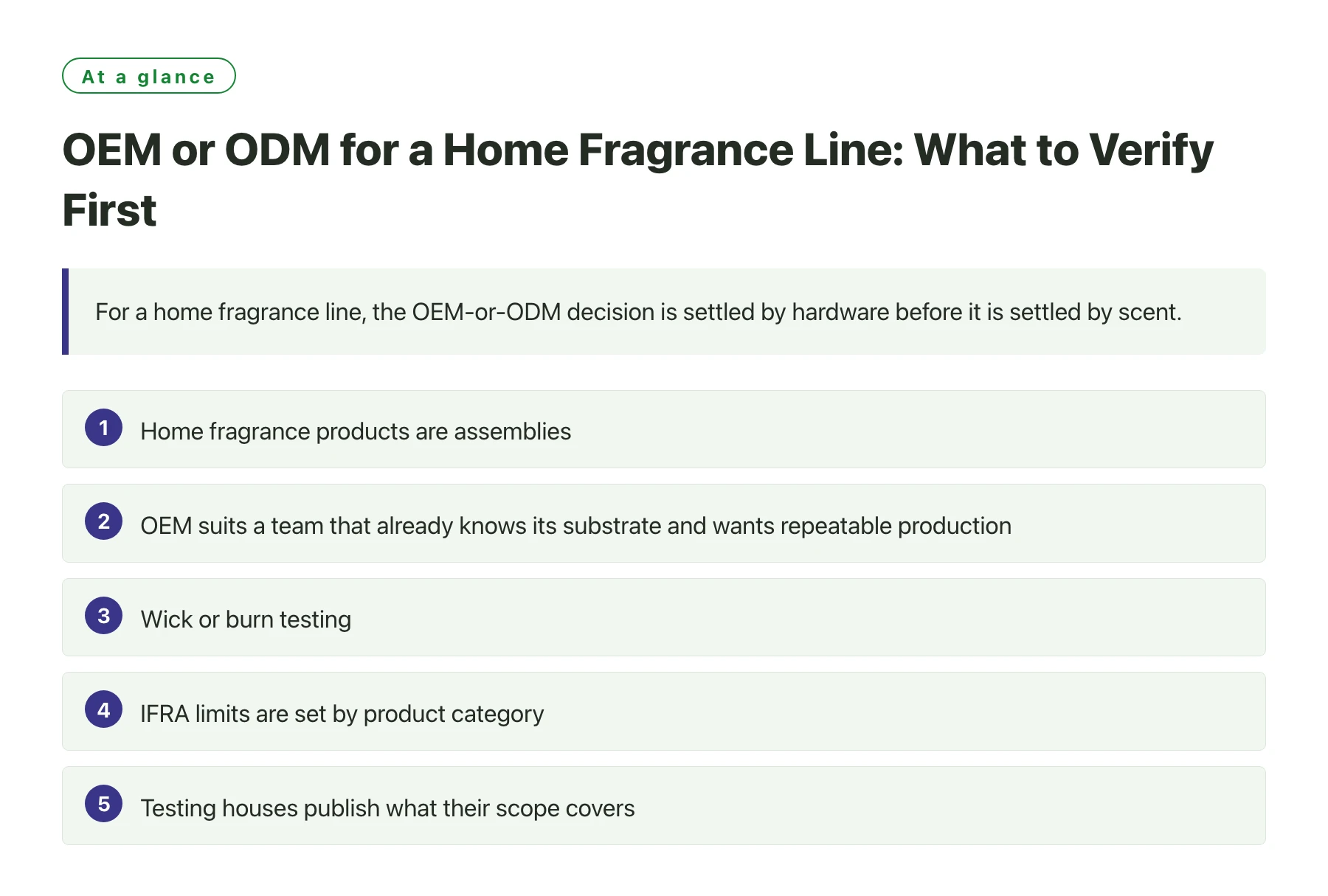
For a home fragrance line, the OEM-or-ODM decision is settled by hardware before it is settled by scent. Reed diffusers, candles and room sprays are delivery systems: the wick, wax, carrier and closure decide whether the fragrance performs, and they are specified separately from the oil. Pick the model that matches who owns that hardware, write the verification steps into the schedule, and the first production run stops being a gamble.
Key takeaways
- Home fragrance products are assemblies, so capability questions start with the substrate, the wick or wax and the closure rather than with the fragrance oil.
- OEM suits a team that already knows its substrate and wants repeatable production; ODM suits a team that needs a working reference product before writing its own specification.
- Wick or burn testing, evaporation testing and seal checks are the three verification steps that separate a home fragrance supplier from a general-purpose filler.
- IFRA limits are set by product category, so a home fragrance brief has to name the category before the oil is chosen [1].
- Testing houses publish what their scope covers, from cosmetic safety to household products, which is how a testing programme gets matched to the product form [2].
Founders often arrive at this decision with a scent brief and a target retail price, and then discover that neither can be answered until someone chooses a delivery system. A reed diffuser, a poured candle and a room spray share a fragrance oil and almost nothing else: different carriers, different filling equipment, different testing, different packaging protection.
That is why the OEM and ODM conversation for home fragrance is shorter when it starts from the hardware. The model tells you who specifies the substrate, who owns the reference sample, and who absorbs the cost of a wick that will not draw or a wax that will not hold the fragrance load.
What follows is the sequence worth working through before a deposit, a tooling order or a wax specification.
Why the hardware decides the model
In an OEM arrangement the brand arrives with a specification: a fragrance oil, a carrier or wax, a wick or wickless format, a fill volume and a closure. The manufacturer's role is repeatability — sourcing the same materials, blending to the same ratio, filling to the same weight, sealing the same way and packing to the same standard on every run. The brand keeps the technical definition and carries the risk if the assembly does not behave at scale.
In ODM the manufacturer develops the concept from a brief, usually from formats it already produces. This shortens the path to a first sample and is often the right choice for a brand whose strength is distribution or positioning rather than formulation. The trade-off is that the starting point is shared unless exclusivity is negotiated, and shared formats tend to appear in more than one catalogue.
Where the technical risk sits
Under OEM, if the approved oil does not disperse in the chosen carrier, or the wick the brand specified will not sustain a clean burn, the corrective work normally belongs to the brand. Under ODM the manufacturer owns that problem, because the format was theirs. Neither arrangement is better in the abstract; the failure mode is choosing one and then behaving as though you chose the other.
What the buyer keeps at the end
Ownership of the formula, the moulds, the artwork files and the approved specification should be settled in the same conversation as the price. A useful test: if the relationship ended next quarter, could another supplier reproduce the product from documents you hold? If not, that gap is a commercial term that has not been negotiated yet.
What each element commits you to
| Element | OEM: you bring | ODM: they bring | Where projects stall |
|---|---|---|---|
| Fragrance oil | A formula or a perfumer's brief | An existing accord adapted to your brief | Oil chosen before the application category is fixed |
| Carrier or wax | A defined base and dosage | A proven base from their range | Dosage set on a small beaker, not on the production substrate |
| Wick or delivery | A specified wick, wickless or spray format | A format they already run | No wick test recorded against the final oil |
| Fill and seal | Exact fill weight and closure | Their standard fill and closure range | Fill weight tolerance never written down |
| Packaging | Artwork and structure files | Support with bottle, closure and carton sourcing | Glass or carton ordered before the fill volume is frozen |
| Reference sample | Signed physical standard | Signed physical standard | Approval given on a photograph |
Read the last column first. Most home fragrance disputes are not about scent quality; they are about a decision that was left implied in one of those six rows.
The verification list that matters
Once the model is chosen, the work changes from strategy to proof. The aim is not to catch anyone out; it is to find out early whether the supplier's process is documented well enough to be repeated at volume, and whether the specification you are paying for is the one they will run.
A manufacturer that handles several home categories under one roof will normally answer these questions with a document rather than an opinion. A partner such as fragrance manufacturing under one roof can describe its own scope in a single list, which also makes its quotation far easier to compare against another supplier's.
Ask for substrate and delivery testing
For a reed diffuser, ask how evaporation rate was measured against the final oil and the chosen wick, not against a control liquid. For a candle, ask for burn tests on the production wax with the production oil at the production dosage. A test run on a different substrate does not transfer, and the difference usually shows up in the first week of retail rather than in the sample room.
Ask how the product is filled and sealed
Fill weight tolerance, headspace and closure torque are three numbers that decide whether a diffuser leaks in transit. Ask for them in writing and ask how they are checked on the line. A factory that fills both fine fragrance and home products will usually have the tolerances documented already, because it has to reconcile them across formats.
Ask what the destination market requires for the product form
Home fragrance is not cosmetic in most markets, which changes the documentation list: safety data sheets, hazard labelling for the liquid, transport classification and packaging obligations rather than a cosmetic product file. IFRA's standards set concentration limits by application category, and a home fragrance brief that has not named its category cannot be checked against them [1]. Testing scope varies the same way, so the programme has to be matched to the product form rather than inherited from a cosmetics template [2].
Ask who writes the fragrance brief
In ODM the brief is the whole project, so it is worth writing it yourself even when the manufacturer develops the answer. State the room, the season, the intended intensity, the substrate and the price ceiling. A brief that only says 'fresh and clean' will come back as the safest accord in the catalogue, which is rarely what a brand wants to be remembered for. The company behind the work can be checked at Xuelei Fragrance before the brief is sent, which saves a round of questions later.
The expensive mistake at this stage is not picking the wrong model. It is picking a model and leaving it implied. Put six things on one page — the model, the substrate, the fill tolerance, the wick or delivery specification, the packaging ownership and the approved reference — and have both sides sign it. Everything else in the project can move; those six should not.
What the first order should prove
A first order is a test of process as much as of product. It should confirm that the supplier can repeat the approved sample, hold the quoted lead time and produce the paperwork the destination market needs. If any of those three fails on a small run, a bigger run will not fix it.
Buyers comparing OEM and ODM quotes often focus on the development fee, which is the smallest number in the file. The larger question is what the line is committed to once the format is fixed: a wick specification, a mould, a carton dieline and a fill tolerance that all have to be respected for the next two years. Suppliers that support both models are used to answering that question directly, and Xuelei publishes an OEM and ODM scope at a manufacturer that supports OEM and ODM for exactly that comparison.
Set pass criteria before the run
Decide in advance what the first order has to demonstrate: fill weight inside tolerance, a decorated vessel that matches the approved artwork, a wick or spray performance test that repeats the sample, and a document pack that satisfies the importer. Written criteria turn scale-up from an impression into a decision.
Make the second order boring
The goal of a first production run is not to impress anyone; it is to make the second run uneventful. Teams that treat the first order as a rehearsal for a predictable process generally scale more smoothly than teams that treat it as a launch.
Sources
- IFRA Standards Library (International Fragrance Association) —— The IFRA Standards Library lists the restrictions the fragrance industry applies to individual fragrance ingredients, based on safety assessments; it is the reference point for compliant fragrance formulation.
- SGS: Cosmetics, Personal Care & Household Testing —— Testing, inspection and certification services for cosmetics and personal care, including microbiological, stability and safety testing aligned with cosmetics GMP.
Frequently asked questions
Is ODM cheaper than OEM for a home fragrance line?
For the first sample, usually yes, because the development work is reused rather than billed. Over the life of the product the answer depends on volume, exclusivity and how much formulation work the brand would otherwise commission separately.
Can a reed diffuser be produced under the same OEM arrangement as a perfume?
The commercial model can be the same, but the specification is not. A diffuser adds a carrier, a wick and an evaporation target to the fragrance oil, so the approval sample has to be a filled, wicking unit rather than a scented strip or a blotter.
What should be in a retained reference sample?
A sealed production unit from the approved batch, labelled with the date, batch number, oil reference and fill weight, held by both the brand and the manufacturer. Approval based on photographs or a memory of a meeting tends to produce disputes at the bulk stage.
How many suppliers should a first-time buyer approach?
Three is usually enough to see how the market answers the same brief, and few enough to keep the comparison honest. Send an identical written brief, including the substrate and the fill volume, and compare the responses line by line rather than on price alone.
Does a home fragrance supplier need cosmetics certification?
Not for a candle or a diffuser, because those are not cosmetic products in most markets. A manufacturer that also produces scented body products will often hold cosmetics GMP anyway, and that is useful context, but it does not replace documentation specific to the product form you are buying.